
Click the play button to listen to the song…
Dear busy parents and caregivers,
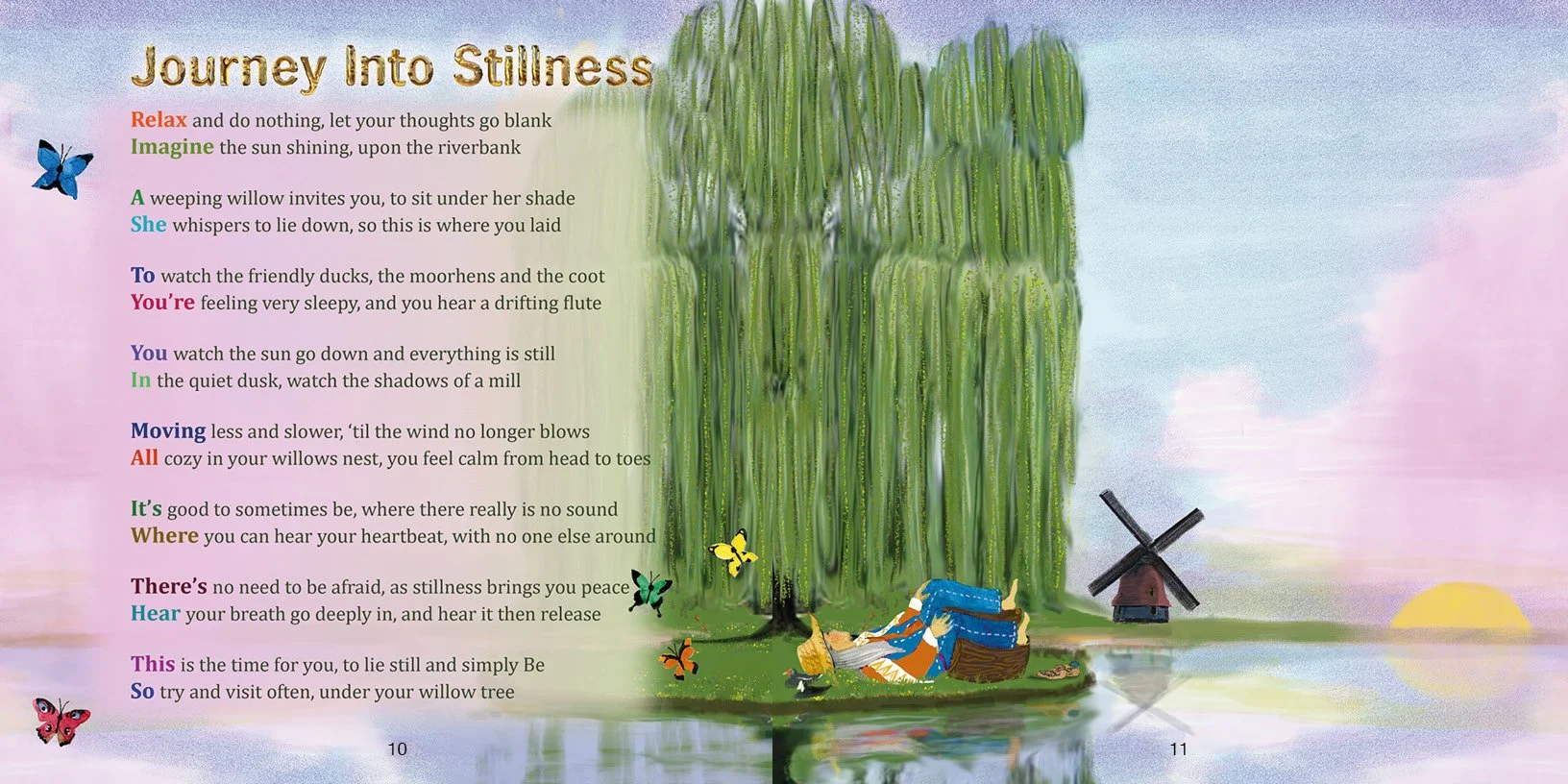
Happy New Year! And to ensure that it is, I am going to help you by giving you ideas of practicing mindfulness each week with the children, explain why this is so helpful for the children, while benefiting yourself. Each Sunday I will post a mindful activity and snippet of a song from one of my books. This week is about how visualisation builds emotional regulation, featuring the page from Joyful Journeys, ‘Journey into Stillness.’
If you’ve ever wished for a pause button in the middle of a busy day, Journey Into Stillness offers one. In the story, children imagine resting beneath a willow tree, listening to birds and watching the water move slowly by. What looks like a simple moment of quiet is actually teaching the brain something important.
Journey Into Stillness helps children learn how to pause, soften within themselves, and enjoy moments of quiet. These gentle practices may seem small, yet a growing body of research shows that visualization and stillness help strengthen the parts of a child’s brain responsible for attention and emotional regulation.
When children imagine calming scenes, the brain networks that support focus and self-awareness become more coordinated. Studies of mindfulness and visualization show that these practices reduce reactivity and help children notice what is happening in their bodies, which is a key foundation for emotional resilience. Over time, children learn how to shift from reacting automatically to observing with curiosity.
Even thirty seconds of quiet can help settle the nervous system. Stillness becomes a place of strength, not of inactivity.
A Simple Practice to Try at Home
Invite your child to sit comfortably with you. Say:
“Let’s pretend we are sitting under a willow tree. Feel the ground beneath you. Imagine the branches gently swaying. Notice how your breath moves when everything around you feels soft and still.”
Afterward, ask:
“What did you notice?”
Children often describe feeling calmer, heavier in their bodies, or more peaceful. But there are no wrong answers here!
This tiny moment builds the skill of settling from the inside out.
Where to Explore More
The Journey Into Stillness pages include:
a gentle song and rhythm designed to guide children into a settled state
a stillness tracker to help children reflect on quiet time
a willow tree colouring activity that invites them to express what calm feels like
Parents can also create a simple “Willow Nest” at home with cushions or soft lighting, as suggested in the Joyful Journeys Activity Pack.
Warmly,
Grandma Mimi
Further Reading
Hölzel, B. K., et al. (2011). How does mindfulness meditation work? Perspectives on Psychological Science, 6(6), 537–559.
Tang, Y. Y., Hölzel, B. K., & Posner, M. I. (2015). The neuroscience of mindfulness meditation. Nature Reviews Neuroscience, 16(4), 213–225.
Zeidan, F., Johnson, S. K., Gordon, N. S., & Goolkasian, P. (2010). Effects of brief mindfulness meditation on mood and cardiovascular variables. Journal of Alternative and Complementary Medicine, 16(8), 867–873.